We represent hundreds of member organisations across Scotland. Our policy recommendations are based on what our members tell us they need, to overcome barriers and unlock benefits for the climate, communities and local economies across the country. We have identified the following key policy asks:
Support community energy groups to build skills and capacity. Scotland must receive its fair share of funding for community energy from the UK Government’s Local Power Plan. We’d like to see increased, multi-year funding for development officers embedded in communities, to support groups across all aspects of community energy, particularly early stage project development and feasibilty studies for new and repowered installations, and upskilling to be ready to engage fully with developers on shared ownership and community benefits opportunities.
Introduce a mechanism to provide long-term security of income for community energy projects. This is crucial for building a business model and securing finance. There are different mechanisms to deliver this, which are being enacted in different contexts; these should be appraised before selecting one. These include the Irish model of Small-Scale Renewable Electricity Support Scheme (SRESS) which includes a specific community tariff, a community energy export guarantee with a long-term guaranteed floor price, or a simplified Contract for Difference scheme.
Give community energy projects priority in the grid connection queue, through community energy designation and/or a project-by-project derogation from certain requirements, like posting securities. Designation would require criteria to be added to the Connections Network Design Methodology (CNDM) for ‘designating’ community-owned energy and storage projects as ‘needed’ for the Strategic Spatial Energy Plan. Those community-owned projects could be included and prioritised within the reformed connections queue.
Require clean energy energy developers to provide community benefit funds. It must also be mandatory for developers to meaningfully engage with the community about the benefit arrangement, and developers must be required to allow communities to have control over how the benefit payments are spent.
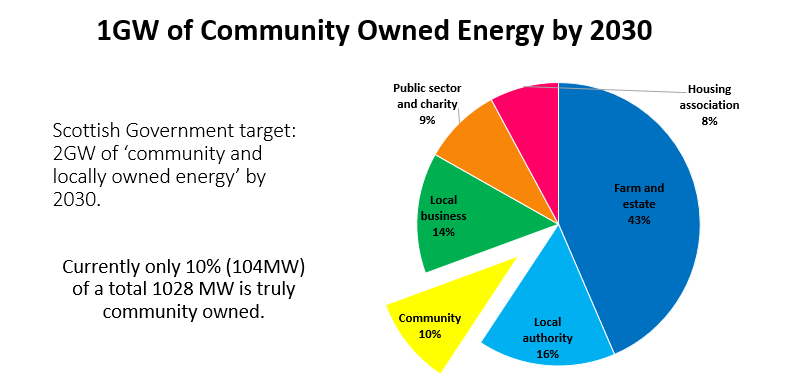
Set a target of 1GW of community-owned energy in Scotland by 2030. This is far more ambitious than the current Scottish Government target of 2GW of “community- and locally-owned energy”, of which only 10% is truly community-owned.1 Scotland must receive its fair share of funding for community energy from the UK Government’s Local Power Plan. This must include a capacity-building funding stream: early-stage funding for new and repowered installations, or to enable communities to self-organise to be ready to negotiate shared ownership and community benefits opportunities when they arise.
Give communities priority to take on land and private renewables developments that are repowering.
a. Support communities to make use of the community right to buy land, for community energy.
b. Public land leases to be offered in first instance to community groups for energy development, when the land is being leased for the first time or the lease needs renewing.
c. New community right to buy all or part of a commercial installation when it approaches repowering.
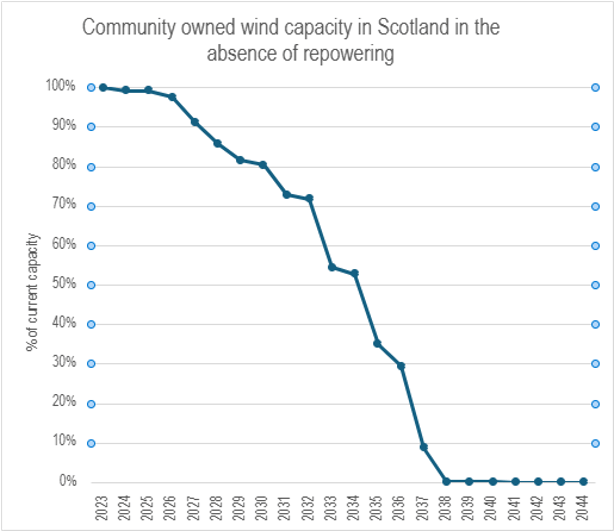
Repowering: reduce barriers and exploit opportunities. Over the next 15 years, large numbers of both commercial and community-owned renewables across Scotland and the UK will need to be repowered. Community groups are facing steep barriers to repowering, and without change, we could lose a substantial amount of the community energy that currently exists. The Scottish Government must help reduce the barriers for community groups to repower and exploit opportunities to shift the balance between private, municipal and community ownership. This could be explored through a working group including stakeholders from the UK Government, Ofgem, NESO, Scottish Government, local authorities, community energy groups and developers.
Scottish Government should review and update the Good Practice Principles for Shared Ownership (2019). In cases where 100% community ownership is not viable, shared ownership between a developer and community can still provide positive impact. Scottish Government set a target for half of all new renewables to be in shared ownership, but only 0.2% of Scotland’s wind power is in shared ownership. Improved community access to finance for Credible Shared Ownership will be key to increasing this figure.
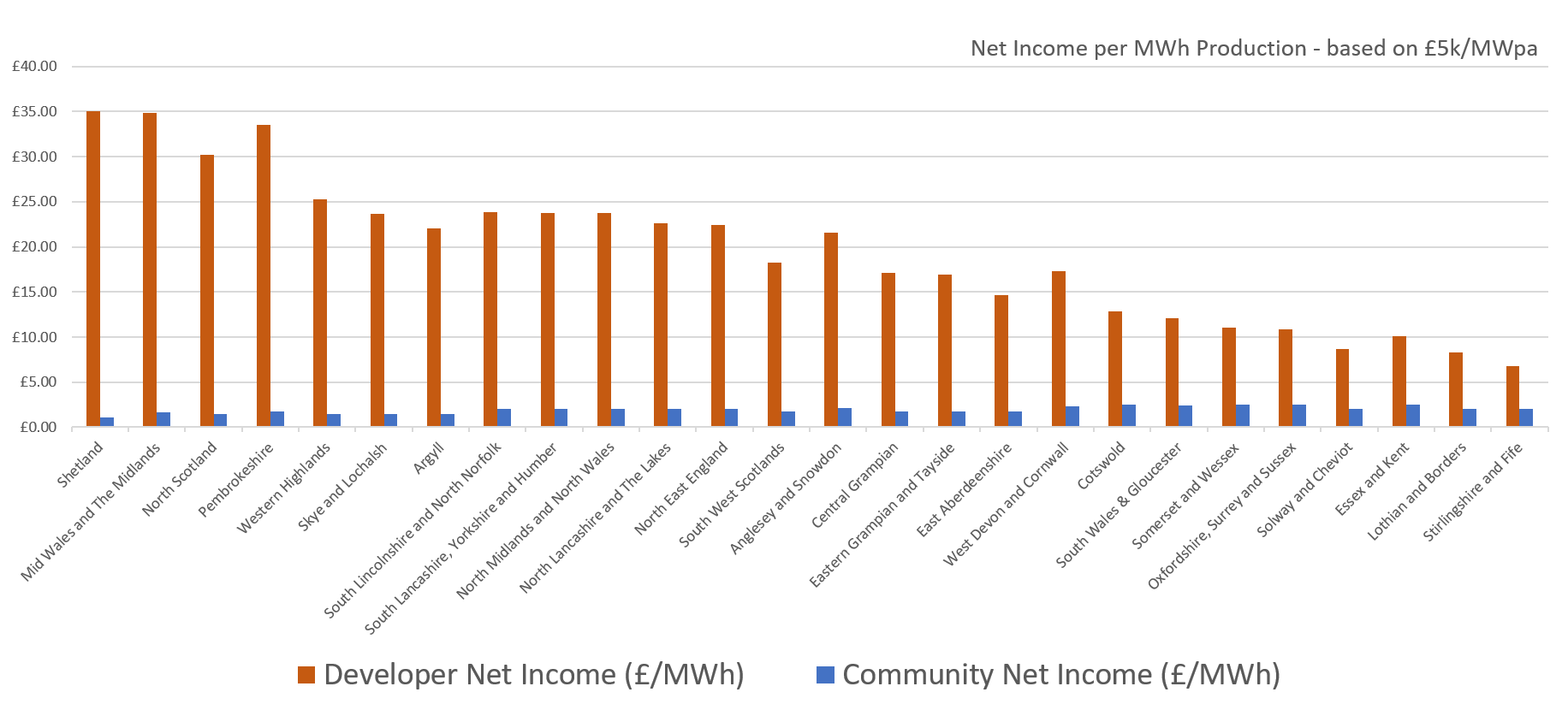
Set new benchmarks for community benefit and urge UK Government to mandate it. The UK Government should set a minimum level of community benefit for each renewables, storage or transmission development. For renewables and storage, we recommend that this be calculated as a percentage of project revenue, i.e. Onshore technologies: 4% of project revenue; Offshore wind (floating/fixed): 1% project revenue. To provide some security of income, for each technology there should be a ‘floor’ (minimum payment level) of £X per megawatt per year, which would be paid even in years when revenue is low. For more information see this link.
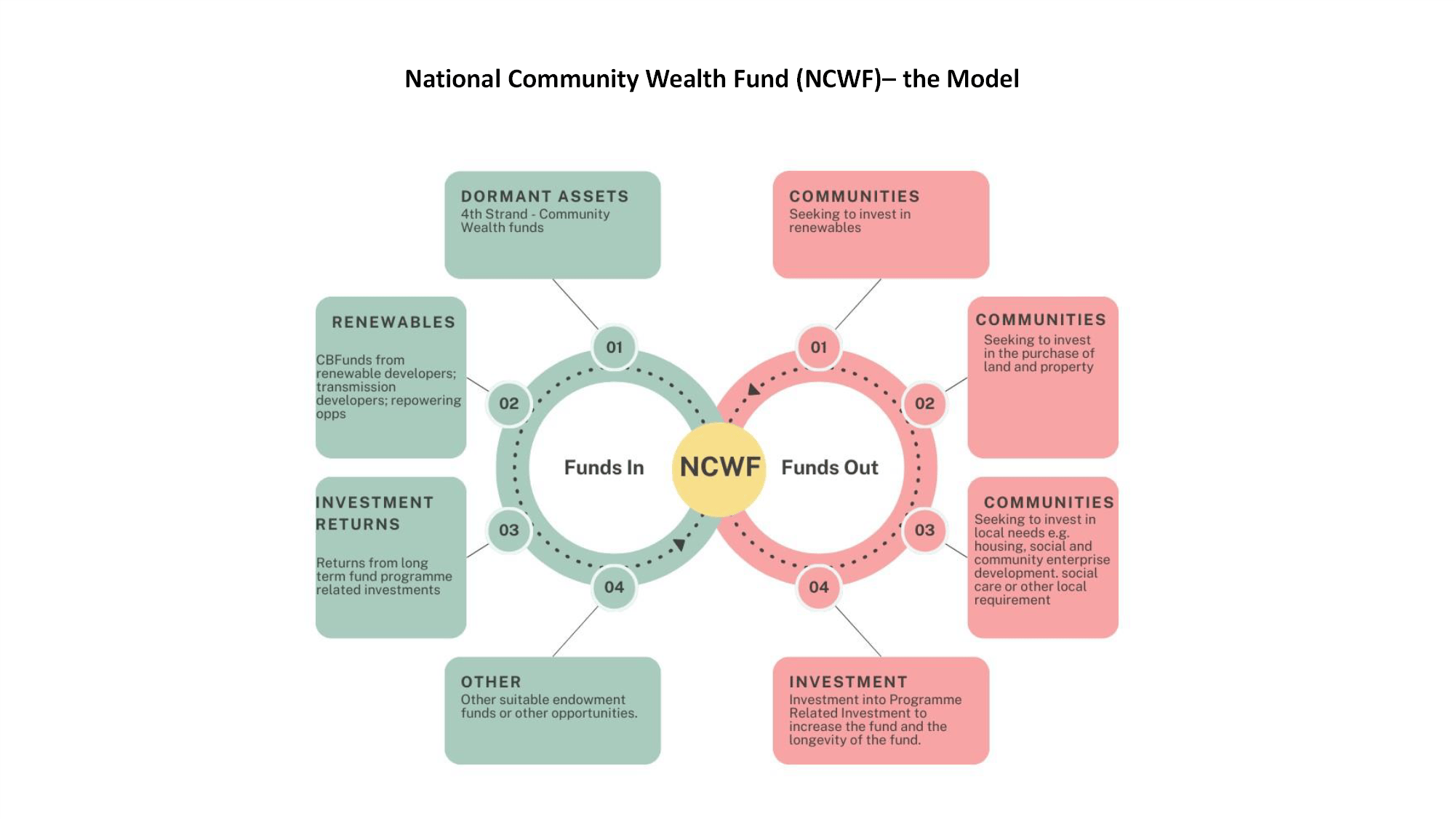
Establish a Scottish Community Wealth Fund. This could be done via the Community Wealth Building Bill or as a commitment for the next Parliamentary session. It would be akin to a sovereign wealth fund but with revenue ringfenced to support community acquisition of assets (land/buildings/renewables) that will create and sustain long-term community wealth across Scotland. This would NOT require Scottish Government upfront investment. It would grow over time with new benefit payments (additional to local community benefits) raised from renewables and transmission developments alongside ongoing contributions from democratic finance (e.g. community shares and bonds) and returns on Community Wealth Fund investment.
Why we are working together
Community Energy Scotland’s vision is of communities actively shaping a low-carbon society that values wellbeing for all. In order to achieve that, we need to bring communities with us and make sure they feel the benefits of the energy transition. Far too many communities are struggling with high energy costs, and feel the energy transition is being done “to them”. SCCE is shaping policy to support communities to take a stake in our energy system, to make ‘just transition’ a reality, not just a catchphrase.
CARES funding announcement: Chief Executive Officer of Community Energy Scotland Zoë Holliday said: “The Scottish Government’s continued commitment to community energy is welcome news for groups across Scotland. The reintroduction of funding for stand-alone generation projects has the potential to lever in significant funds locally and play a key role in the just transition. We are also delighted to see a new fund focussing on capacity building for communities; we have been calling for such support to ensure that when it comes to the energy transition, no community is left behind.”
Zoë Holliday
Chief Executive Officer of Community Energy Scotland
Community Energy Scotland’s vision is of communities actively shaping a low-carbon society that values wellbeing for all. In order to achieve that, we need to bring communities with us and make sure they feel the benefits of the energy transition. Far too many communities are struggling with high energy costs, and feel the energy transition is being done “to them”. SCCE is shaping policy to support communities to take a stake in our energy system, to make ‘just transition’ a reality, not just a catchphrase.
Amanda Grimm
Policy Manager
Community Benefits Consultation: Zoë Holliday from the Scottish Community Coalition on Energy said: “We commend the Scottish Government for committing to update the Good Practice Principles for community benefits. Since its establishment, the Scottish Community Coalition on Energy has been calling for these to be overhauled to reflect current technologies and context. Now is the time to be ambitious and to make improvements to the guidance to ensure a Fair Deal from the energy transition for communities across Scotland.”
Zoë Holliday
Chief Executive Officer of Community Energy Scotland
DTAS believes the renewable energy transition must deliver a fair and equitable share of wealth and benefits to communities across Scotland. Our priority is to empower community-led organisations to take an active role—not just as participants, but as owners and decision-makers. By championing democratic ownership and local control, we can help create a more just, inclusive, and community-driven energy future.
Morven Lyon
Development Trusts Association Scotland
Scottish Community Coalition on Energy spoke at the Scottish Greens’ conference. We are politically neutral and aim to work with all major parties in Scotland, in order to influence policy to achieve a Fair Energy Deal.
Photo Gallery
Community and locally owned energyRepoweringCommunity benefit payments as proportion of developer incomeScottish National Community Wealth Fund
Partner Links
Community Energy Scotland, 67A Castle Street, Inverness, IV2 3DU